 English
 日本語
日本語
 Italiano
 汉语
汉语
 Deutsch
 Français
 Español
 Português
 Türkçe
 Polski
 Українська
 한국어
한국어
 Việt
Việt
 ภาษาไทย
 Русский
 čeština
 Nederlandse

Strategy #13 for solving Sudoku: Y Wing
Y-Wing is a technique that helps solve Sudoku puzzles by eliminating candidates in certain cells. The principle of the Y-Wing strategy is not difficult; the most challenging part is to identify the arrangement of cells containing the necessary candidates on the game board. This strategy is advantageous to use for complex Sudokus.
Sudoku Y-Wing Tutorial
Below, we'll provide a brief instruction on how to identify cells to which you can apply this technique:
1. Fill in all cells with pencil marks (candidates).
2. Find 3 cells that contain 2 candidates each and meet the following conditions:
◉ There is a pairwise connection between the candidates. That is, the first cell shares a candidate with the second cell, and the second candidate matches a candidate in the third cell. For the second cell, the first candidate is linked to the first cell, and the second candidate coincides with the candidate in the third cell. Similar connections apply to the candidates from the third cell.
In letter form, this can be written as: ab; bc; ca. Where a, b, c are possible candidates.

◉ One of the cells "sees" the other two cells simultaneously. By "seeing," we mean that the cell is in the same row, column, or 3x3 block as the other two cells.
3. The next step is to find a cell that simultaneously "sees" both bc and ca and remove candidate c from it. This is because if the cell is at the intersection of a row and column where c definitely exists, then candidate c cannot be in the current cell according to Sudoku rules.
It takes a lot of practice to learn to see these invisible connections between cells.
Sudoku Y-Wing Examples

In the example above, we see the Y-Wing pattern (red lines) on the game board on the left. Three cells contain candidates 3, 7, 9, and they are connected (highlighted with orange circles). The cell with candidates 3, 9 is in the same 3x3 block as the cell with candidates 7, 9, and in the same column as the cell that has candidates 3, 7. Therefore, all conditions of our strategy are met.
Note that the cells with candidates 7, 9 and 3, 7 have a common candidate 7. According to the Y-Wing strategy, the cell that is at the intersection of the row containing the cell with notes 3, 7 and the column containing the cell with notes 7, 9 cannot contain the assumption with the number 7 (highlighted with a red square). Therefore, we remove this assumption and see the result on the game board on the right.

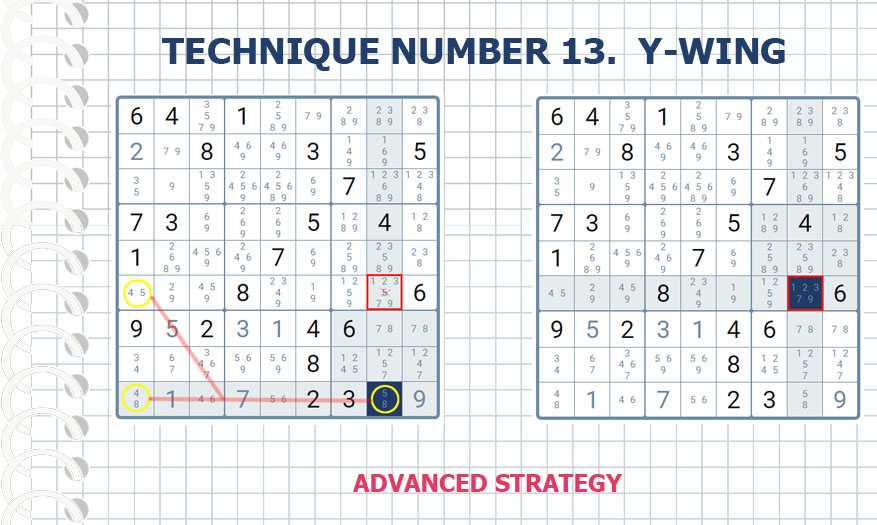
In the second example above, you can see the same Y-Wing technique, but the cells of interest are arranged slightly differently. The cells of interest are circled in yellow. According to our strategy, the cell with candidates 4, 8 is analogous to ab; the cell with candidates 4, 5 is analogous to bc; the cell with candidates 5, 8 is analogous to ac.
Now let's apply the Y-Wing technique. Here, the candidate c is represented by the number 5, as it is common to the cells with candidates 4, 5 and 5, 8. The intersection of the column containing the ac cell and the row containing the bc cell gives us a cell (highlighted with a red square) where candidate 5 cannot be present. We remove this candidate and see the result on the game board on the right.
Any questions? Feel free to ask them in the comments; we'll be happy to answer. Want to play a very difficult Sudoku? Go to the online Sudoku section and play for free without restrictions!