 English
 日本語
日本語
 Italiano
 汉语
汉语
 Deutsch
 Français
 Español
 Português
 Türkçe
 Polski
 Українська
 한국어
한국어
 Việt
Việt
 ภาษาไทย
 Русский
 čeština
 Nederlandse


Strategy #12 for solving Sudoku: X wing
X-wing is an advanced technique for solving complex and very complex Sudoku. This strategy will help you eliminate unnecessary candidates. Using only this technique, it is impossible to completely solve Sudoku, so you need to know other Sudoku techniques as well. For a regular beginner, it may seem like a very complex strategy. But don't worry, the main thing is to read this instruction, look at the example of Sudoku x-wing, and then try to solve evil Sudoku on our website.
Sudoku x-wing rules
Below we will consider the algorithm of your actions to find and apply the x-wing method to solve the wing:
1. Fill in the empty cells on the game board with candidates. You can do this for all numbers or for one number, for example, indicate in which cells the number 3 can be.
2. Find 2 rows or 2 columns in which there are 2 cells with the same candidate. Do not pay attention to other assumptions in these cells, you should be interested in the specific common digit in these 4 cells.
3. The sought-after 4 cells can be located in different 3 by 3 blocks, but they must form a square or rectangle with vertices in these cells. If the conditions of this item are not met, you need to look for suitable cells with the same pencil entries further.
4. If you have successfully completed all the previous points, remove the extra candidates from the 3 by 3 blocks, rows, or columns. Because according to the rules of Sudoku, a digit cannot be repeated in a row, column, or 3 by 3 square.
Sudoku X-wing examples

In the screenshot above, you can see a fragment of a Sudoku game where we applied the X Wing technique. On the game board to the left, the essence of the X Wing strategy is shown for the case when cells diagonally connected have only two values in one row (the number 7 is highlighted in yellow and orange). This means that the number 7 can only be placed diagonally in 2 positions: when 7 is circled in orange or when 7 is highlighted in yellow. But no matter where these numbers are located, they still conflict with other number 7s that are in the same column or the same 3*3 block. Therefore, the next step is to remove the extra assumptions with the number 7 in other cells (highlighted with red X's on the diagram).
Now look at the game board on the right, there are no extra candidates 7, and only one cell in the third block has a single candidate 7, so we will immediately fill it with a large number 7.
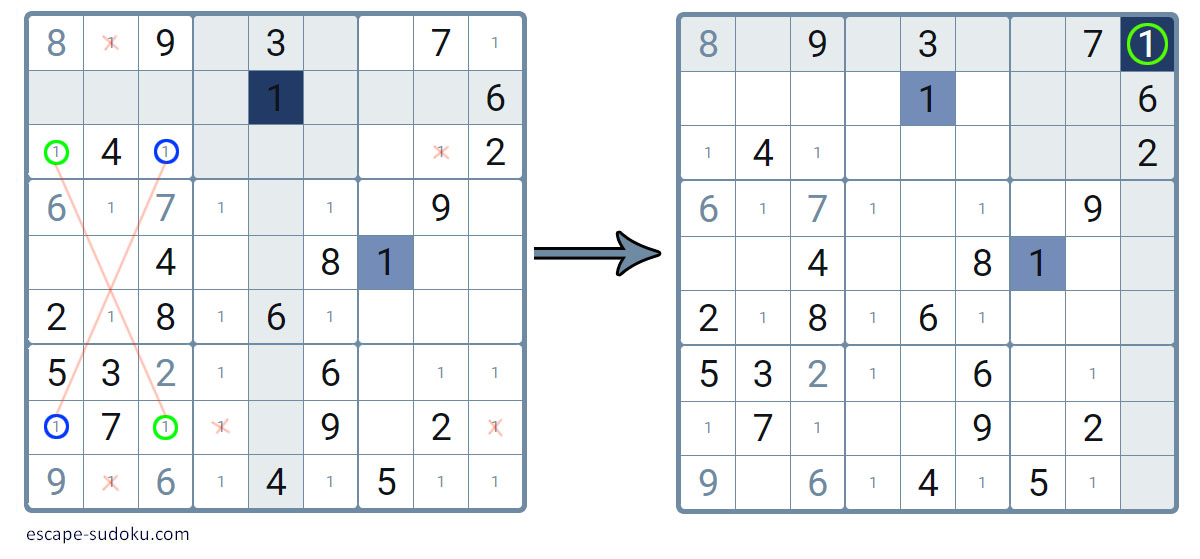
In the second example (image above), the case is shown when the X diagonals are formed by columns. We have filled in all the assumptions for the number "1". As we can see, in the first and sixth 3 by 3 blocks, assumptions of the number 1 (green and blue circles) are located, which occur in the row and column only twice, so we can apply our tactic again and remove the extra assumptions with the number 1 in rows, squares 3*3.
On the game board on the right, we see the result of our strategy's work, thanks to removing the extra candidates, we can set the large number 1 in the third square.
Conclusion: This is a rather complex technique designed for experienced Sudoku players. In the X Wing method, the most difficult thing is to find and see cells that have a certain value and can form an X-wing. It is easier to search for rectangles with the same assumption values than to search for diagonal connections. Try it out, train your logic, and play evil Sudokus with Escape Sudoku!